Types of Espresso Machines: Which Kind Is Right for You?
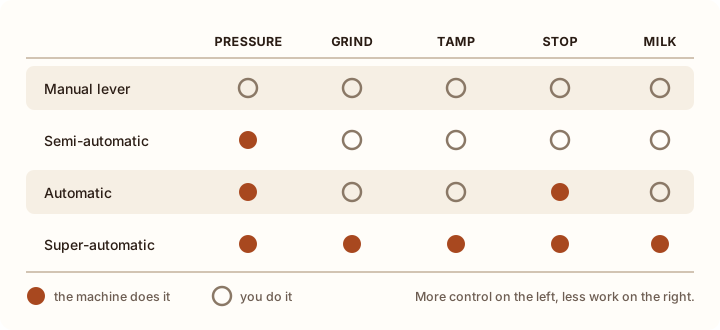
There are five main types of espresso machine. Manual lever machines use your arm to create pressure. Semi-automatic machines use a pump and let you start and stop the shot. Automatic machines stop the shot for you. Super-automatic machines grind, dose and brew at one touch. Capsule machines brew from sealed pods.
Key takeaways
- The types differ mainly in how much the machine does for you.
- Semi-automatic is the most common choice for home espresso and offers the best balance of control and cost.
- Super-automatic machines trade some flavor and control for convenience.
- Separately from type, the heating system decides whether you can brew and steam at the same time.
Shop for an espresso machine and you run into a pile of overlapping terms: manual, semi-automatic, automatic, super-automatic, prosumer, bean-to-cup. Most of them describe one thing, which is how much of the work the machine does and how much is left to you.
Sort that out and the choice gets much simpler.
The five main types at a glance
| Type | You do | The machine does | Best for |
|---|---|---|---|
| Manual lever | Grind, tamp, pull the lever | Heats the water | Enthusiasts who want full control |
| Semi-automatic | Grind, tamp, start and stop the shot | Pumps and heats | Most home users |
| Automatic | Grind, tamp, press start | Pumps, heats, stops the shot | People who want consistent volume |
| Super-automatic | Press a button | Everything | Convenience above all |
| Capsule | Insert a pod, press a button | Everything | Speed and no cleanup |
Manual lever machines
These are the original espresso machines. There is no pump. You pull a lever, and that movement, either directly or by compressing a spring, pushes water through the coffee.
Why people choose them: you control the pressure through the whole shot, they are quiet, mechanically simple, and many are beautiful objects. Small portable lever brewers also exist that need only hot water.
The catch: they are the hardest to learn. Results depend on your technique as much as your grind, and consistency takes practice.
Semi-automatic machines
This is what most people picture: a machine with a portafilter, a pump and a steam wand. You grind the coffee, tamp it, lock in the portafilter and press a button or flip a switch to start the pump. You stop it when the shot is done.
Why people choose them: they give control over the things that matter, namely grind, dose and shot length, while the machine takes care of pressure and temperature. They cover every budget, from about a hundred dollars to several thousand.
The catch: there is a learning curve, and you need a capable grinder or a machine with one built in.
Most machines recommended for home use are semi-automatic, including those in our guide to the best espresso machines for beginners.
Automatic machines
Sometimes called volumetric machines. They work like a semi-automatic, with one difference: the machine measures the water and stops the shot automatically when it reaches a programmed volume.
Why people choose them: press the button and walk away. Every shot has the same volume, which is useful when making several drinks.
The catch: volume is not the same as a good shot. If the grind is off, the machine delivers a consistent amount of poorly extracted espresso. You still grind and tamp.
Many home machines blur this line. Breville’s Barista and Bambino machines have programmable shot buttons and can also be run manually.
Super-automatic machines
Also called bean-to-cup machines. You fill the hopper with beans and the tank with water. Press a button and the machine grinds, doses, tamps, brews and drops the used puck into an internal bin. Most froth milk as well, either with an automatic wand or a milk carafe.
Why people choose them: nothing is easier while still using fresh beans. They suit households where several people want different drinks and nobody wants to learn technique.
The catch: you give up control and some quality. The internal brewing unit uses less coffee at lower pressure than a good semi-automatic setup, and the built-in grinders are modest. They also have more parts to clean and maintain, and they cost more to repair.
Capsule machines
Capsule machines brew from sealed, pre-ground pods. Nespresso is the best-known example. They are fast, tidy and consistent.
The catch: the cost per cup is higher, the choice is limited to what comes in a capsule, and the shots are milder than espresso from fresh-ground beans. We look at how close they come in is Nespresso real espresso.
Two types that are not really espresso
- Steam-driven machines. Very cheap machines with no pump use steam pressure of only a bar or two. They make strong coffee, not espresso.
- Stovetop moka pots. Often called stovetop espresso makers. They work on the same principle and also fall well short of espresso pressure. See how to make espresso without a machine.
The other thing to know: heating systems
Separate from type, machines differ in how they heat water. This affects temperature stability and whether you can brew and steam at once.
- Thermoblock or thermocoil: heats water on demand. Fast to warm up.
- Single boiler: one boiler for brewing and steaming, used one after the other.
- Heat exchanger: one boiler that allows brewing and steaming together.
- Dual boiler: separate boilers for each job, with the most precise control.
These apply mostly to semi-automatic machines. We explain how each works in how an espresso machine works.
What “prosumer” means
You will see this word on machines from around $1,000 upward. It is a blend of professional and consumer, and describes home machines built with commercial-grade parts: heavy metal construction, a 58mm group head, and a heat exchanger or dual boiler. It describes build quality, not a separate category of operation. Nearly all prosumer machines are semi-automatic.
How to choose
Ask yourself three questions.
- Do you want to learn a skill, or do you only want the drink? If the drink, look at super-automatic or capsule machines. If the skill, look at semi-automatic.
- Do you mostly drink milk drinks? If so, steaming performance matters, and so does being able to brew and steam without waiting.
- What is your total budget, including a grinder? For semi-automatic machines, the grinder matters as much as the machine.
For most people who enjoy coffee and are willing to practice, a semi-automatic machine is the right answer. Our guide to the best espresso machines under $1,000 covers the models worth considering.
Households that also drink drip coffee can look at coffee and espresso combo machines.
Two of these types have their own explainers: what is a semi-automatic espresso machine and volumetric espresso machines explained.
Frequently asked questions
What is the difference between semi-automatic and automatic espresso machines?
On a semi-automatic machine you start and stop the shot yourself. An automatic machine measures the water and stops the shot when a programmed volume is reached. In both cases you still grind and tamp the coffee.
What is a super-automatic espresso machine?
A machine that does everything at the press of a button: it grinds the beans, doses and tamps the coffee, brews the shot and discards the puck. Many also froth milk automatically.
Which type of espresso machine is best for beginners?
A semi-automatic machine with stable temperature and a pressurized basket is a good first choice if you want to learn. A super-automatic or capsule machine is easier if you only want the drink.
Is a manual espresso machine better?
Not better, but different. A lever machine gives complete control over pressure and can make excellent espresso. It also demands the most skill and a good grinder.