How to Grind Coffee Beans Without a Grinder: 5 Ways
You can grind coffee beans without a grinder using a blender, a food processor, a mortar and pestle, a rolling pin or a hammer. Work in short bursts and small batches. The grounds will be uneven, which is fine for French press, cold brew and drip coffee but not consistent enough for espresso.
Key takeaways
- A blender or food processor is fastest: pulse in short bursts and shake between pulses.
- A mortar and pestle gives the most control and the finest grind, in small amounts.
- Uneven grounds suit forgiving methods such as French press and cold brew.
- Many grocery stores and coffee shops will grind beans for you, often for free.
How to grind coffee beans in a blender: the short version
You will need: whole coffee beans, blender with a lid.
- Add a small amount of beansPut a quarter to half a cup of beans in a dry blender jar and close the lid.
- Pulse in short burstsPulse for three to five seconds at a time on a medium-high setting.
- Shake between pulsesTilt or shake the jar between bursts so the larger pieces fall back toward the blades.
- Check and repeatStop when the grounds look right for your brew method, usually after 20 to 30 seconds of total pulsing.
It usually happens the same way. You buy a bag of whole beans by mistake, or your grinder breaks, and you want coffee now. You do not need a grinder to get a drinkable cup. You need something that can break the beans up and a little patience.
The one thing to know in advance is that every method here produces uneven grounds: some powder, some larger pieces. That matters more for some brew methods than others, which we will come to.
1. Blender (fastest)
A blender is a blade grinder with a bigger jar. It works well if you resist holding the button down.
- Put a quarter to half a cup of beans in a dry jar and close the lid.
- Pulse for three to five seconds at a time.
- Tilt or shake the jar between pulses so the big pieces fall back to the blades.
- Stop after about 20 to 30 seconds of total pulsing, or when it looks right.
Running the blender continuously heats the coffee and gives you dust at the bottom and whole beans on top. Bullet-style blenders such as a NutriBullet or Magic Bullet work the same way, and the milling blade, if you have one, is the better choice.
Best for: coarse to medium grinds.
2. Food processor
This is the same technique with a wider bowl. Pulse in short bursts and shake or scrape between them. Because the beans have more room to escape the blade, the result is a bit less even than a blender’s. Use at least half a cup so the blades have something to catch.
Best for: coarse grinds for French press or cold brew.
3. Mortar and pestle (most control)
This is the oldest method and the one that gives the finest, most even result. It is also the slowest.
- Fill the mortar no more than a quarter full.
- Press down and twist the pestle to crack the beans.
- Once they are cracked, grind in a circular motion against the sides.
- Keep going until the texture suits your brew method.
A few tablespoons at a time is the limit. With effort you can get close to a fine grind, which no blade can do reliably.
Best for: small amounts, medium to fine grinds.
4. Rolling pin
- Put the beans in a sturdy zip bag, press the air out and seal it. Wrap the bag in a towel.
- Press down with the rolling pin to crack the beans.
- Roll back and forth with firm pressure, shifting the grounds around every so often.
A wine bottle or a heavy jar does the same job.
Best for: coarse to medium grinds.
5. Hammer or meat mallet
Bag the beans and wrap them in a towel as above. Press down and crush instead of swinging. Hard blows split the bag and scatter coffee across the kitchen. Work from one side of the bag to the other.
Best for: coarse grinds only.
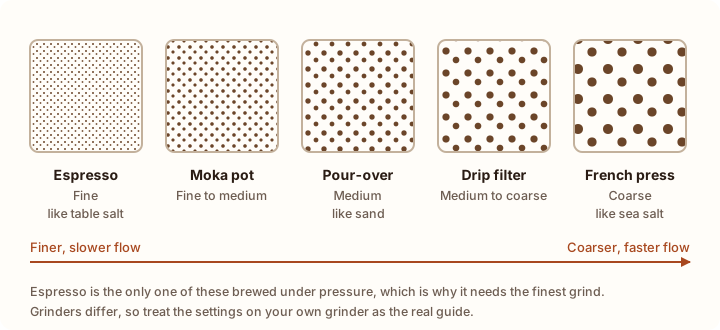
Which grind for which brew method
| Brew method | Grind needed | Works with these methods? |
|---|---|---|
| Cold brew | Extra coarse | Yes, any of them |
| French press | Coarse | Yes, any of them |
| Drip coffee maker | Medium | Yes: blender or mortar and pestle |
| Pour-over | Medium-fine | Acceptable: mortar and pestle |
| Moka pot | Fine | Difficult: mortar and pestle only |
| Espresso | Fine and very even | No |
Why this does not work for espresso
Espresso is the one method where improvised grinding fails. The machine pushes water through the coffee at high pressure, and the water takes the easiest route. With uneven grounds it rushes past the large pieces and leaves the fine ones over-extracted, so the shot tastes sour and bitter at once.
Espresso also needs a specific fineness that you adjust in tiny steps, which a blender cannot do. We explain what is required in our guide to espresso grind size.
If your machine has a pressurized basket, roughly ground coffee will produce something drinkable, but it will not be good. For an alternative that suits improvised grounds, see how to make espresso without a machine.
Let someone else grind it
Often the easiest answer is to not grind at home at all.
- Grocery stores frequently have a grinder in the coffee aisle for beans bought there.
- Coffee shops and roasters will usually grind a bag you bought from them for free. Tell them how you brew and they will choose the setting.
- Warehouse clubs sometimes have grinders near the exit, though not all locations still do.
Ask for an espresso grind only if you will use the coffee within a few days. Ground coffee loses flavor quickly, and fine grounds lose it fastest.
Tips that apply to every method
- Grind small batches. Only what you need for that brew.
- Check as you go. Stop and look often. You can grind more, but you cannot undo dust.
- Sift if you can. Shaking the grounds through a kitchen sieve removes the finest powder, which is what makes coffee bitter and muddy.
- Clean the blender well. Coffee oils linger and will flavor the next thing you make.
When to buy a grinder
If this is a one-off, any method above will get you through. If you make coffee daily, a burr grinder is the single biggest improvement you can make, because it crushes beans to an even size instead of chopping them at random. For espresso it is not optional. Our guide to the best espresso grinders covers the options, including hand grinders that cost far less than electric ones.
Frequently asked questions
Can you grind coffee beans in a blender?
Yes. Use short pulses of a few seconds, small batches, and shake the jar between pulses. Running the blender continuously heats the coffee and produces a mix of dust and large chunks.
Can you grind coffee beans in a food processor?
Yes, in the same way as a blender. Pulse in short bursts and scrape or shake between them. The wider bowl makes the result a little less even, so it is best for coarse grinds.
Where can I get coffee beans ground for free?
Many grocery stores have a grinder in the coffee aisle for beans bought there, and coffee shops will usually grind a bag you bought from them at no charge. Some will grind beans from elsewhere if you ask politely.
Can I brew coffee with whole beans without grinding them?
Technically yes, by simmering whole beans in water for about an hour, but it uses a lot of coffee and tastes weak. Roughly crushing the beans first gives a far better result.