Espresso Grind Size: How Fine to Grind and How to Adjust
Espresso needs a fine grind, a little finer than table salt and coarser than flour. The right setting is the one that gives you about twice the weight of liquid as dry coffee in 25 to 30 seconds. If the shot runs fast and tastes sour, grind finer; if it drips slowly and tastes bitter, grind coarser.
Key takeaways
- There is no universal number. The correct setting depends on your grinder, your beans and how fresh they are.
- Judge by time and taste: aim for a 1:2 ratio in 25 to 30 seconds, then adjust by flavor.
- Fast and sour means grind finer. Slow and bitter means grind coarser.
- Change one thing at a time, and make small adjustments.
Grind size is the main control you have over an espresso shot. Dose, tamping and temperature all matter, but none of them changes the result as much as moving the grinder a notch. Most disappointing shots at home trace back to it.
The good news is that the logic is simple once you see it.
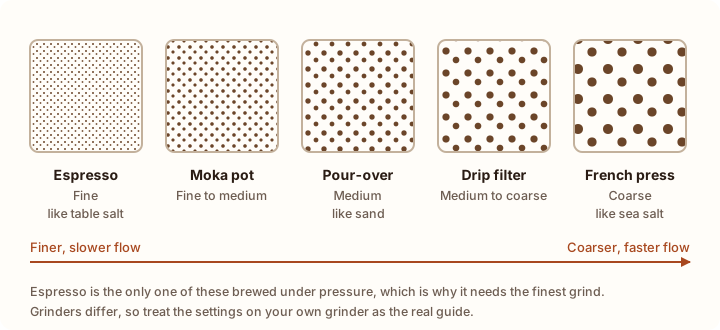
How fine is espresso grind?
Fine, but not powder. The usual comparison is table salt, or a touch finer. Rub a pinch between your fingers: it should feel like fine sand and clump together a little.
| Brew method | Grind | Looks like |
|---|---|---|
| Turkish coffee | Extra fine | Flour |
| Espresso | Fine | Fine table salt |
| Moka pot | Fine to medium-fine | Slightly coarser than espresso |
| Drip coffee | Medium | Regular sand |
| French press | Coarse | Coarse sea salt |
That description gets you in the right area. It cannot tell you the exact setting, because that is different for every grinder and every coffee.
Why grind size matters so much
In an espresso machine, the coffee itself is what holds the water back. Finer particles pack together more tightly, so water passes through more slowly. Coarser particles leave bigger gaps, so water passes quickly. We explain the mechanics in how an espresso machine works.
How long the water spends in the coffee decides what it pulls out:
- Too coarse: water rushes through in 10 to 15 seconds. It only extracts the sour, sharp flavors. The shot looks pale and thin.
- Too fine: water struggles through over 40 seconds or more. It extracts harsh, bitter compounds. The shot is dark and can taste burnt.
- About right: the shot flows like warm honey, finishes in roughly 25 to 30 seconds, and tastes balanced.
How to find the right setting
This process is called dialing in. You need a scale that reads to a tenth of a gram and a timer. The one on your phone is fine.
- Pick a dose and keep it fixed. For a double shot, 18 grams is a common starting point. Check what your basket is designed for.
- Choose a target. Aim for twice the dose in liquid: 18 grams in, 36 grams out.
- Pull a shot and time it. Start the timer when you start the pump. Stop the shot when the scale reads 36 grams.
- Read the result.
- Under 20 seconds: grind finer.
- Over 35 seconds: grind coarser.
- Between 25 and 30 seconds: taste it.
- Adjust by taste. Sour or sharp means go slightly finer. Bitter or dry means go slightly coarser.
- Repeat. It commonly takes three to five shots to settle a new bag.
Two habits make this much easier. Change only one thing at a time, so you know what caused the difference. And after changing the setting, grind and discard a few grams, because the first coffee out is still from the old setting.
Sour or bitter? A quick reference
| What you notice | Likely cause | What to do |
|---|---|---|
| Fast shot, sour, thin, pale crema | Grind too coarse | Grind finer |
| Slow shot, bitter, dark, little liquid | Grind too fine | Grind coarser |
| Right time but sour | Under-extracted | Slightly finer, or run the shot a little longer |
| Right time but bitter | Over-extracted | Slightly coarser, or stop the shot a little earlier |
| Spurting or uneven flow | Channeling | Distribute the grounds evenly and tamp level |
Why the setting does not stay put
Many people find a good setting and assume the job is done. Then the shots drift.
Coffee is not stable. For the first weeks after roasting, beans release carbon dioxide and gradually extract faster. As a bag ages, you will usually need to go a little finer to keep the same shot time. A new bag, a different roast level, or a humid day can all move the setting as well.
Dark roasts are more brittle and usually need a coarser setting. Light roasts are denser and usually need a finer one. Decaf often needs to go finer still, as we cover in is there decaf espresso.
Does the grinder matter?
A great deal. Espresso is sensitive to tiny changes, so the grinder needs two things: the ability to grind fine enough, and steps small enough to make fine adjustments.
- Blade grinders chop unevenly and cannot be adjusted. They do not work for espresso.
- Entry-level burr grinders built for drip coffee often cannot go fine enough, or have steps that are too far apart.
- Espresso-capable burr grinders have fine or stepless adjustment designed for this job.
If your shots swing from too fast to too slow between two neighboring settings, the grinder is the limit, not your technique. Our guide to the best espresso grinders covers what to look for.
What about pre-ground coffee?
Pre-ground espresso is a fixed grind, so you lose the ability to adjust, and it goes stale within days of opening. It can work in a pressurized basket. See can you use regular coffee in an espresso machine for when that makes sense.
Machines with built-in grinders
On machines such as the Breville Barista Express, the grind dial on the side is the main adjustment. If you reach the finest setting and shots are still too fast, most of these machines have a second adjustment on the upper burr inside the hopper. The manual shows how to change it.
Wondering what happens at the other extreme? See can you use coarse ground coffee for espresso.
Frequently asked questions
What grind setting should I use for espresso?
It varies by grinder, so there is no single number. Start in the fine range your grinder's manual suggests for espresso, pull a shot, and time it. Adjust finer or coarser until about 18 grams of coffee gives about 36 grams of espresso in 25 to 30 seconds.
What should espresso grind look like?
Fine and slightly gritty, similar to fine table salt or a little finer. Pinched between your fingers it should clump lightly and feel like fine sand, not powdery like flour and not coarse like sugar.
Can espresso be ground too fine?
Yes. If the grind is too fine the water cannot get through, so the shot drips slowly or the machine chokes entirely. The result tastes bitter and harsh.
Why does my grind setting keep changing?
Coffee changes as it ages. Beans lose carbon dioxide after roasting and extract faster over time, so you usually need to grind a little finer as a bag gets older. A new bag, a different roast or a change in humidity can also shift the setting.