Espresso Machine Pressure Gauge: How to Read and Use It
An espresso machine pressure gauge shows how much pressure builds during a shot. A brew gauge should read about 8 to 10 bars, or sit in the marked espresso range. A low reading usually means the grind is too coarse; a very high reading means it is too fine. A separate boiler gauge shows steam pressure, normally 1 to 1.5 bars.
Key takeaways
- Brew gauge: pressure during the shot. Boiler gauge: steam pressure. They measure different things.
- Low reading: grind finer or increase the dose. High reading: grind coarser.
- The gauge is feedback on your grind as much as on the machine.
- A portafilter gauge can test machines that have no built-in gauge.
A pressure gauge looks like a readout of how well the machine is working. More often it is a readout of how well the coffee was prepared. Understanding that makes the gauge far more useful.
Two kinds of gauge
Some machines have one, some have both, and many have neither.
| Gauge | Measures | Normal reading |
|---|---|---|
| Brew pressure | Pressure in the brew circuit during a shot | About 8 to 10 bars |
| Boiler or steam pressure | Pressure in the steam boiler | About 1 to 1.5 bars |
A boiler gauge is found on heat exchanger and dual boiler machines. It tells you the steam boiler is up to temperature. It has nothing to do with the shot.
Reading the brew gauge
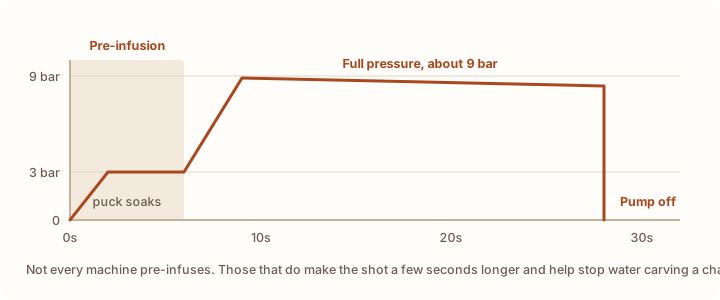
At rest the needle sits at zero. When you start a shot, it rises as pressure builds against the coffee, holds steady, then drops when you stop.
| Reading during the shot | What it means | What to do |
|---|---|---|
| Barely moves | Almost no resistance | Grind much finer; check the dose |
| Below the espresso range | Too little resistance | Grind finer or add a little coffee |
| In the range, about 8 to 10 bars | Good | Check time and taste |
| Above the range | Too much resistance | Grind coarser or reduce the dose |
| Rises, then suddenly drops | Channeling | Improve distribution and tamping |
Some gauges, such as those on Breville’s Barista machines, show a shaded espresso zone instead of numbers. The principle is the same.
Why the reading depends on the coffee
Pressure builds only when something resists the water. In an espresso machine, that is the puck. A coarse grind lets water through, so the gauge stays low even though the pump is fine. See espresso machine pressure explained.
That makes the gauge a quick check on your grind:
- Low: see espresso grind size and go finer.
- Dropping mid-shot: see espresso channeling causes and fixes.
Where the gauge measures
Most built-in gauges read pressure near the pump, not at the coffee. The pressure at the puck is slightly lower. Treat the reading as a guide, and do not chase an exact number.
Testing the machine itself
To check the machine independently of the coffee:
With a blind basket. Fit the basket with no holes and run the pump for a few seconds. The gauge shows the maximum the machine delivers, which is set by its over-pressure valve.
With a portafilter pressure gauge. This is a portafilter with a gauge fitted to it, sold as an accessory. Locked into the group, it shows pressure at the group head. It is useful for machines with no built-in gauge and for checking or adjusting the over-pressure valve.
Run the pump only briefly against a blind basket, and check the manual first.
If the machine reads too high
Some machines leave the factory set to 12 bars or more. That is not harmful, but many owners find shots smoother at around 9. On some models the over-pressure valve can be adjusted. Check the manual and the effect on your warranty before trying.
If the machine reads low even with a blind basket
Then the cause is in the machine: a leaking gasket, scale, air in the pump or a worn pump. See espresso machine low pressure.
Do you need a gauge?
It is a good teacher. Watching the needle helps beginners connect grind changes with results. It is not essential. Shot time and taste tell you the same things, as described in how to dial in espresso.
Frequently asked questions
What should the pressure gauge read on an espresso machine?
During a shot, about 8 to 10 bars on a numbered gauge, or within the zone marked for espresso. At rest it reads zero. A boiler gauge, if fitted, normally reads 1 to 1.5 bars.
Why is my pressure gauge not moving?
If the shot runs fast and the needle barely moves, the coffee is too coarse or the dose too low to create resistance. If nothing flows at all, the pump may be air-locked. A stuck or faulty gauge is rare.
Do I need a pressure gauge on my espresso machine?
No. It is a helpful learning aid, but timing the shot and tasting it tell you the same things. Many excellent machines have no gauge.
This article is part of our guide: Espresso Machine Accessories: The Ones Worth Buying